County Emergency Agency Warns That a Warm Winter Can Still Hit Hard
A very strong El Niño favors a warmer winter, but the county EMA rates ice, outages and road damage as high threats. What it says and what to do now.

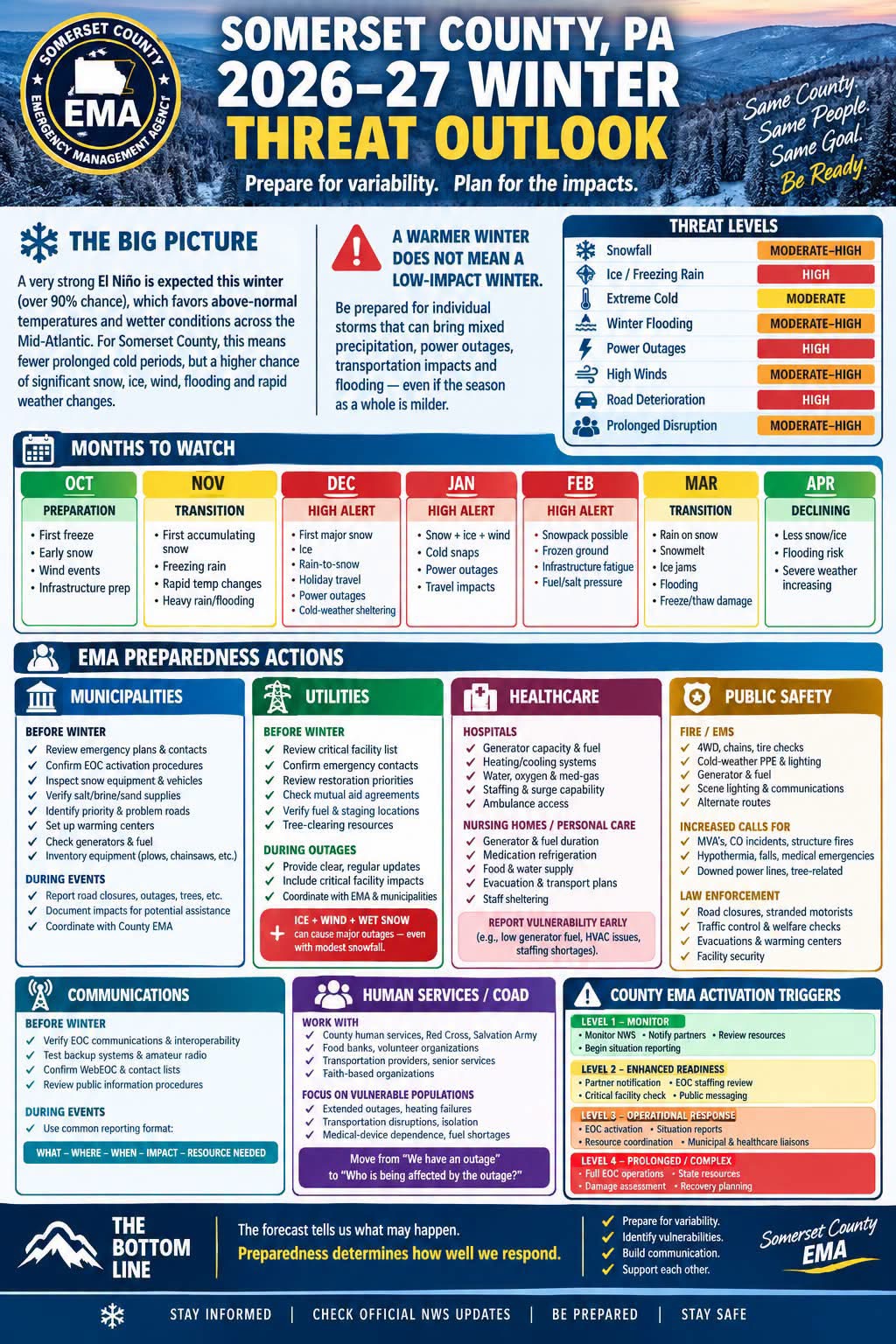
Somerset County’s Emergency Management Agency is telling local governments, utilities and hospitals to get ready for a winter that looks mild on paper and may not behave that way.
In its 2026-27 Winter Threat Outlook, the agency points to a very strong El Niño, which it puts at better than 90 percent. The National Weather Service’s Climate Prediction Center agrees. Its September 10 update gives better than 90 percent odds of a very strong event this fall and winter, and a 75 percent chance it ends up the strongest since records began in 1950.
What that means for Pennsylvania is less certain. NOAA’s outlook leans warmer than normal for December through February, but forecasters see no strong signal on precipitation and are not calling snowfall this far out. The EMA’s read is that fewer long cold spells do not make an easy season. It expects a better chance of heavy snow, ice, wind, flooding and fast swings between them.
The agency rates ice and freezing rain, power outages and road deterioration as high threats. Snowfall, winter flooding, high winds and prolonged disruption rate moderate to high, and extreme cold moderate. Its sharpest warning is that ice, wind and wet snow together can knock out power over a wide area even when the snowfall itself is modest.
The EMA calls October the month to prepare and November a transition, with December through February on high alert. March has its own trouble: rain on snow, snowmelt, ice jams and flooding.
Most of the checklist is aimed at the people who run things. Towns are asked to check salt and plow supplies, utilities to review restoration plans, hospitals and nursing homes to test generators and fuel, and fire and EMS crews to check chains and tires. The agency also wants weak spots reported early, such as low generator fuel or a heating problem, not after the lights go out.
The household version is shorter. If you heat with oil, check the tank now, with oil at $5.70 a gallon statewide. Test the flashlights and batteries, and make sure any medication that needs refrigeration has a plan. A generator belongs outdoors, well away from the house, never in a garage. And look in on neighbors who depend on electric medical equipment.
After August, nobody on the mountain needs convincing that the weather has a long memory. A warm winter is not the same as an easy one.